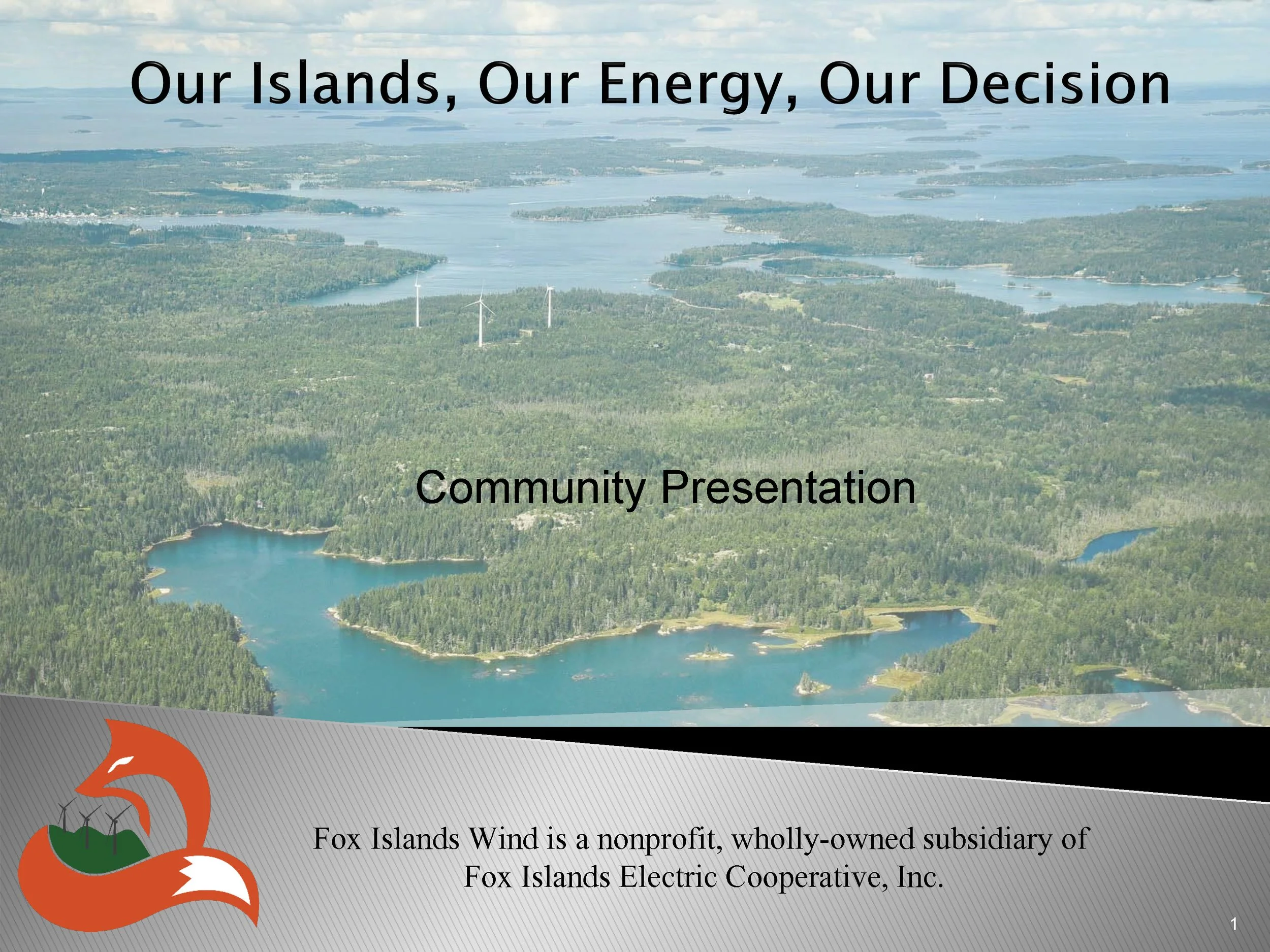
OUR ISLANDS, OUR ENERGY, OUR DECISION
FIEC members/customers voted in favor of repowering our wind turbines in July 2025. Visit this page periodically for updated information about the repowering project.
Repowering our Turbines
Repowering will cost about $9.5M, which will be paid for with grants and low-interest loans.
FIEC customers will pay for the energy from the repowered turbines through their electric bills.
Repowering would take place in 2029.
$0.13/kWh average power cost
-
CUSTOMER BILL IMPACT
How much will customers pay for energy?
-
FINANCIAL MODELING
Energy and Transmission Costs
-
HISTORICAL AND MODEL ENERGY COSTS
Comparing historical costs with the models
-
TRANSMISSION COSTS
Transmission costs could become more expensive than energy.
-
MEETING ENERGY DEMAND
FIEC will need approximately 12,000 MWh to serve its load in 2030.
-
SOLAR GENERATION ANALYSIS
Solar can help, but it is not a solution by itself.
FREQUENTLY ASKED QUESTIONS
-
1. What does it mean to repower the turbines?
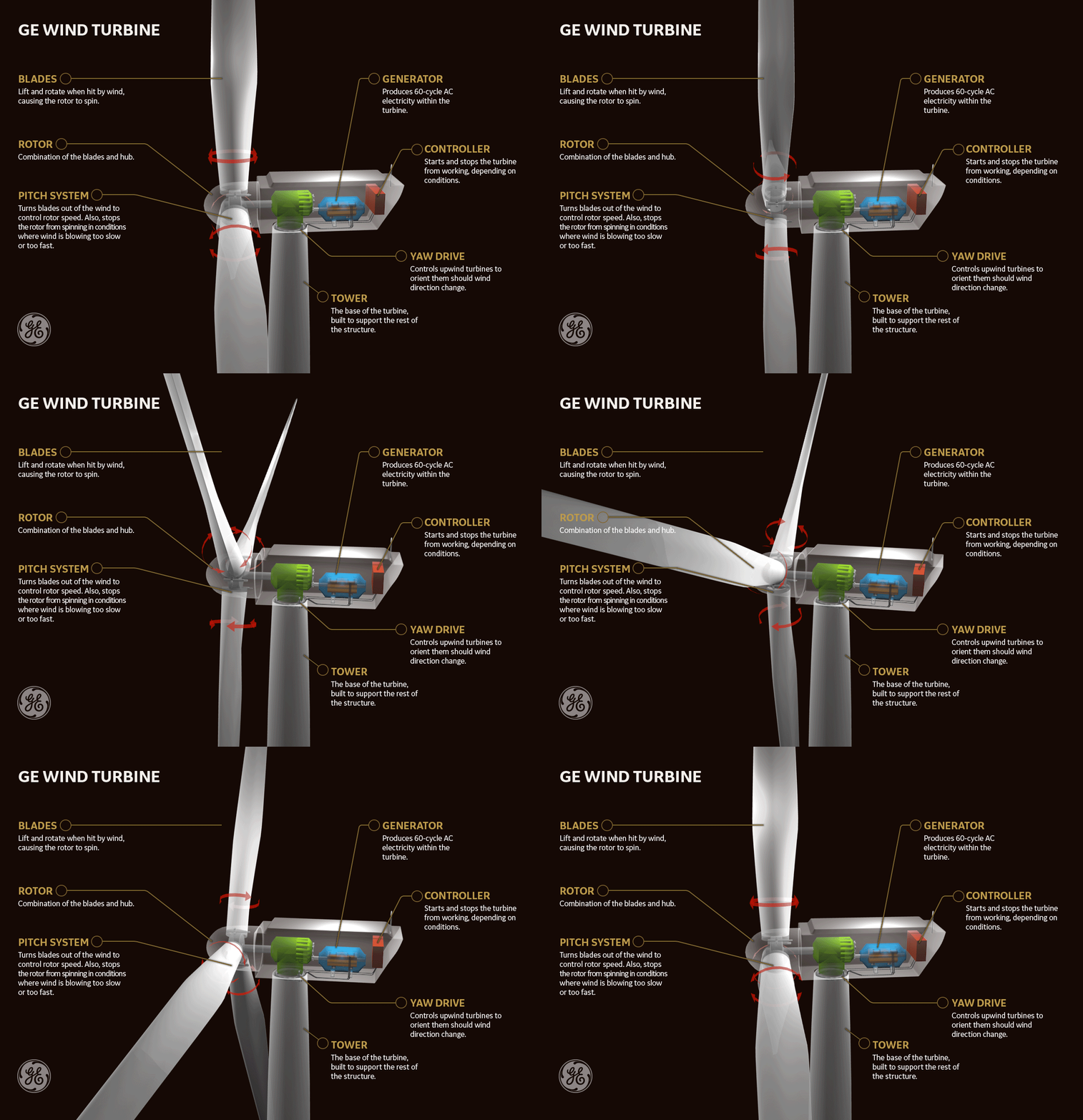
“Partial repowering” is the replacement and upgrade of outdated and worn-out equipment inside the turbine, as well as the blades, with modern, more efficient versions. The existing towers, foundations, and other fixed infrastructure remain at the site and will be used again.
2. What do we gain by repowering?
Because the new components are more efficient and more reliable than the existing aging equipment, repowering should increase our energy production by about 30%. Repowering will also extend the operating life of our turbines by another 20 years. Repowering will also cost less than the original project, reducing and stabilizing our energy costs.
3. Is FIW adding more turbines during the repowering?
No.
4. If members vote to repower, what is the timeline?
Repowering would take place in 2029-2030.
5. If members vote to decommission, what is the timeline?
Decommissioning would likely take place in 2033-2034, with the timing based on the condition of the turbines and maintenance costs.
6. What are FIEC’s current energy sources?
FIEC purchases energy from Fox Islands Wind (60%), the mainland energy market (39.9%), with emergency backup generation from its diesel generator (0.01%).
7. Did FIEC/FIW consider other energy sources to replace the wind farm? For example, utility-scale solar with a battery?
Yes, FIEC and FIW evaluated other renewable resources before determining that another resource could not replace the generation output of the wind farm. While a small-scale solar array is part of our overall strategic plan to serve our summer peak population, solar generation is not a feasible option to replace the wind farm due to the low average solar radiation resource on the islands and land constraints. Click here for an analysis of solar generation feasibility.
8. Are there other renewable energy sources that could replace the wind turbines?
FIW and FIEC have investigated a wide range of possible energy sources on the islands, but no other known energy sources are viable by themselves to fully replace the wind farm (4.5 MW). If the members vote to decommission, FIEC will have to rely on mainland energy sources.
9. Why does decommissioning cost so much money ($2.5M)? Can’t we just turn them off and walk away?
FIW’s operating permits require FIW to remove the turbines and restore the land. It will be expensive to rent a crane, dismantle and transport all components off the island for recycling, reconfigure the electric grid, and restore and revegetate the surface of the site.
-
1. How will the repowering and decommissioning options affect my power bill?
Repowering is expected to reduce the Energy Charge on your bill, saving the average customer about $216 a year. FIEC and FIW are also working on battery storage, which will further reduce our energy costs by storing excess wind energy to be used during peak periods when energy from the mainland is the most expensive. Review the data.
On the other hand, decommissioning would require FIEC to purchase all of its power form mainland sources, with projected higher energy prices. Review the data.
Over the last decade, the average retail price for electricity in Maine increased by the third highest rate in the country, according to an analysis by The Maine Monitor, surpassed only by California and Massachusetts. In addition, FIEC has historically lost about 8% of the energy purchased from the mainland market from unavoidable line losses in our 15-mile submarine power cable due to electrical resistance. This lost energy must still be paid for by FEIC and included in the energy costs for our customers. In contrast, energy generated by FIW is delivered straight to FIEC’s substation on Vinalhaven with very little, if any, line loss.
2. What is FIEC’s historical energy cost? What would the costs have been if we had never constructed the turbines?
The wind turbines saved FIEC customers $1.4 million since 2008, with an average power cost of $0.10/kWh. Repowering should result in similar savings in the future. Review the data.
3. How does the construction cost for repowering compare to the original project?
Repowering will cost less than the original project because we will borrow less money at a much lower interest rate (2% versus 4%), and we can reuse the towers and other components. The original wind project cost $14.5M. FIW had borrowed $9.5M at 4% interest (resulting in a total cost of $13,846,326). Tax credits and private investment covered the remaining project cost. The repowering project will cost about $9.5M. FIW has a 25% grant ($2,375,000) and will borrow the remaining $7,125,000 at 2% interest (total principal and interest of $8,662,310). It will cost $5,184,016 less to finance the repowering compared to the original project, while at the same time increasing the energy production of the turbines by about 30%. Review Project Financing and Energy Production data.
4. Is the New ERA funding secure in the new administration?
Yes. The current administration supports rural electric cooperatives and projects that benefit rural America, and has recently reviewed and re-confirmed our award.
-
1. Will there be any environmental impacts on the property?
FIW does not anticipate any additional environmental impacts to the site. During repowering, only the equipment in the nacelle, rotors, and blades are replaced while the towers, foundations, and the overall site will remain unchanged. FIW will be performing a wide range of environmental and technical reviews, including wetland habitat and wildlife reviews, sound studies, and noise modeling for the new turbine equipment.
2. What are the noise considerations of repowering?
FIW will be performing a detailed sound study to model and evaluate the acoustic profiles of the new equipment under multiple wind and weather conditions. The new repowering components are much more efficient than our early-generation turbines that were originally installed, and modern turbines and blades have been designed to reduce sound impacts on surrounding areas. FIW is committed to an open and transparent process, and as part of the state regulatory process will provide FIEC members with notice and an opportunity to comment.
3. How much greenhouse gas (GHG) is offset by the turbines?
The original project offsets 2,836 tons of CO2e each year, about 49% of FIEC’s GHG emissions. The repowered turbines will offset over 5,000 tons of CO2e annually, making FIEC’s generation 89% GHG-free. FIEC and FIW are working on utility-scale solar and battery storage, which would achieve close to 100% GHG-free generation on our islands.
-
1. When will the original $9.5M loan be paid off?
FIW will pay off the original loan in December 2029.
2. Can the Maine DEP and FIW be sued again?
Lawsuits can be a risk for any project, but FIW now has the resources in place to anticipate, manage, and mitigate legal challenges. FIW will also continue to meet the requirements of its operating permits and maintain its open and transparent communications with the communities.
3. Why should we repower when the turbines are still running?
Certain turbine components are reaching their end-of-life, with more frequent equipment failures and steadily increasing maintenance costs. FIW can keep the turbines running as long as feasible through maintenance and minor repairs, but the gearboxes, blades, rotors, and other key equipment do need to be replaced in the near future if the turbines are to operate another 20 years.
4. What did we learn from the first project?
The current governance and management of FIW have analyzed and learned from the first project. The turbines are complicated machines with thousands of parts that must be operated and maintained with ongoing investment to deliver reliable power. The new FIW board and staff have expertise in business planning, financial modeling, and management of renewable energy projects – and are local resources who are and will remain personally invested in the success of the project.
5. How will repowering be managed differently from the original project?
FIW has the staff and resources to execute the repowering project according to federal and state regulations, making sure that all proper steps are taken in the permitting process and that the repowered turbines are appropriately maintained. The repowering project proposal is based on experience and data and is free from outside interests.
6. What role does the diesel generator play in each option?
FIEC will continue to operate and maintain the diesel generator as a backup energy source. FIEC cannot use the generator as baseload generation because it is expensive, subject to a restrictive air pollution permit that limits the hours it can run, and not large enough to meet FIEC’s peak demand of 2.5 MW. The generator costs about $300/MWh to operate (FIW is about $95/MWh).
Email your questions to CustomerService@FoxIslands.net.